
|
Getting your Trinity Audio player ready...
|
In a year when nothing about Eurovision 2025 has been quiet, here comes another twist in the glitter cannon.
According to an investigation published by the EBU’s new fact-checking service Spotlight, Israel’s Government Advertising Agency paid for an international campaign encouraging people to vote for Israel’s Eurovision entry, ‘New Day Will Rise’ by Yuval Raphael.
Yes, you read that correctly. Spotlight reported that Google-platform advertisements targeted audiences in 35 participating countries and told viewers they could vote for Israel up to 20 times. And, to be fair, Israel topped the public vote. It was the juries that rained on their parade, handing Austria the win with JJ’s ‘Wasted Love’.
You need proof though, surely…
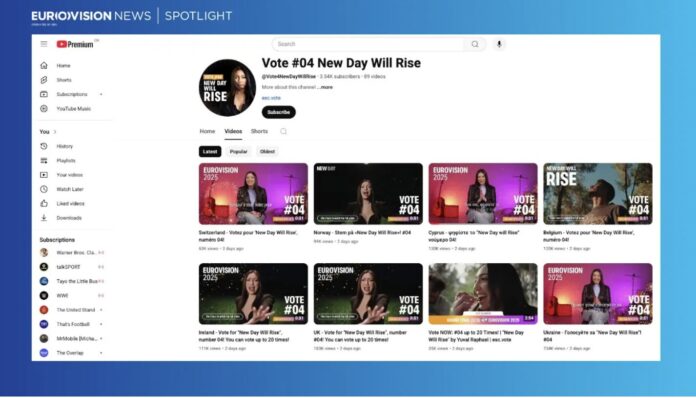
Analysis of a YouTube account created on April 20, 2025, with the username @Vote4NewDayWillRise, found that it published 89 videos between May 6 and May 16, initially recording more than 8.3 million views on the platform. The YouTube channel was not officially acknowledged as a government account. However, analysis of the Google Ads Transparency Center (Archived here) identified the verified advertiser as the Israeli Government Advertising Agency.
That distinction matters: the evidence establishes a state agency as the verified Google advertiser, not that the YouTube channel itself was directly operated by the Israeli government.
Ahead of both the semifinals and Grand Final, the official social media accounts of the State of Israel amplified voting messages across several platforms, including Instagram (Archived here), TikTok (Archived here), and X (Archived here).
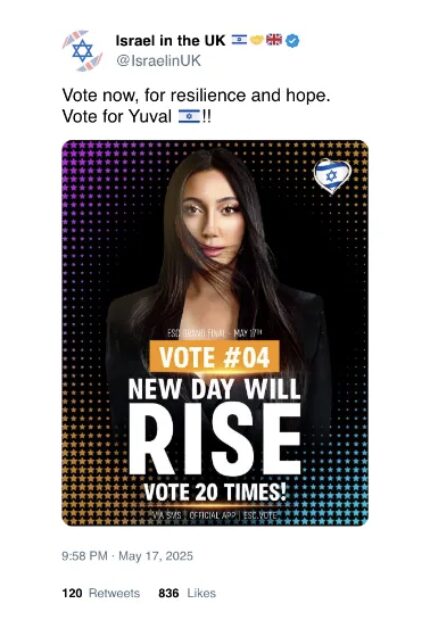
Israeli embassies worldwide were also encouraging people to “vote 20 times” for Raphael ahead of both performances, including the embassies of Israel in the United Kingdom (Archived here), Sweden (Archived here), and Denmark (Archived here).
The body behind this research, Spotlight, is the EBU’s shiny new initiative for fighting misinformation and promoting transparency. Launched in early 2025, it brings together public broadcasters across Europe to dig into fishy claims, with a particular focus on stories that might otherwise fly under the radar. And it seems Eurovision is very much on their radar.
But… Eurovision ads are allowed, right?
Indeed, so before we all scream “fix!”, there is a technicality: Eurovision rules don’t explicitly ban promotional campaigns for entries. Plenty of delegations promote their acts. You can’t move for mentions of Malta, Finland, Sweden and the UK on the socials (other countries are available).
The EBU’s position, as quoted by Spotlight, was that paid promotion by broadcasters, record labels or other third parties is permitted provided it does not instrumentalise the contest or breach editorial guidelines. But when the advertising comes from a government agency—and when that same entry has been the subject of political protests, statements, and walkouts—you can see how eyebrows might be raised.
What the campaign did — and did not — prove
Spotlight reported that the advertisements seen in countries awarding Israel high televote scores had generated more than 4.2 million views at the time of publication. Israel received at least 10 public-vote points from 19 countries, including 12 points from Australia, Azerbaijan, Belgium, France, Germany, Luxembourg, the Netherlands, Portugal, Spain, Sweden, Switzerland and the United Kingdom.
That is evidence of reach, not evidence that the advertising caused Israel’s result. Spotlight found no evidence of artificial or irregular voting and said the result had been checked and verified. The official Grand Final result was Austria first with 436 points, Israel second with 357, and Estonia third with 356. Israel received the highest public score, 297 points, but only 60 jury points. Austria received 258 jury points from juries and 178 from the public.
State-funded Eurovision promo campaign
Spotlight’s ‘scoop’ therefore supports a narrower, but still awkward, conclusion: a state agency paid for a large targeted promotional campaign for Israel’s entry. It does not establish that the campaign caused Israel’s second-place finish, nor that it was formally found to breach the contest rules.
Eurovision rules explicitly state that the contest “is a non-political event”, and all participating broadcasters are responsible for ensuring that measures are taken to avoid the contest becoming politicised or “instrumentalised”.
The extensive promotion of Raphael notably omitted any mention of KAN, the Israeli Public Broadcasting Corporation. Spotlight inferred from that that KAN was not directly involved in the advertising campaign, but that remains an inference rather than a confirmed finding.
EBU HQ is already busy sifting through complaints from national broadcasters about everything from vote miscounts to flag restrictions. They found time to issue a boilerplate response to (their own) fact-checking agency:
Martin Green CBE, Director of the Eurovision Song Contest, said:
“The Eurovision Song Contest’s rules are designed to ensure a fair and neutral competition. These rules do not prohibit participating broadcasters or third parties such as record labels or others from promoting their entries online and elsewhere, as long as such promotion does not instrumentalize (sic) the Contest or breach its editorial guidelines. Many delegations employ paid promotion campaigns to support the song, profile, and future careers of their artists.”
Green also said that the voting partner and an independent compliance monitor had checked the results for suspicious or irregular patterns. That is the EBU’s position, rather than an independent ruling that every aspect of the campaign complied with every applicable rule.
The Spotlight report raises yet another awkward question for the Eurovision Song Contest team: if public votes can be reached by state-funded advertising, are we still judging the music—or the marketing?
In a contest that thrives on spectacle, this latest development might just be the most quietly controversial one yet.
A note on what happened afterwards
Subsequent updates to the Spotlight investigation reported that SocialBlade data showed the YouTube channel losing 28.6 million views on 17 May, suggesting that videos may have been deleted or made private. One previously unlisted video had reportedly exceeded 25.2 million views before removal. Spotlight said the final scale of the channel’s view total remained unclear.
Later reporting also said that the EBU introduced tighter voting measures for the following contest, including reducing the maximum number of votes per payment method from 20 to 10. That was a later change, not an action already taken when this article was first published on 20 May 2025.