

|
Getting your Trinity Audio player ready...
|
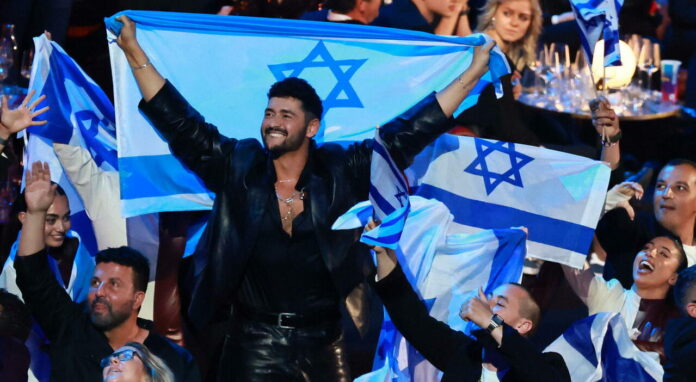
At the 2026 Eurovision Song Contest held in Vienna last weekend, Israel finished second for the second consecutive year. Noam Bettan, who performed “Michelle” – co-written by last year’s Israeli entrant Yuval Raphael – collected 123 points from juries and 220 from the televote, with the audience booing audibly as the televote figures were read out.
None of that would have been remarkable in isolation. The context was everything. Israel competed despite a five-country boycott. Spain, Ireland, the Netherlands, Slovenia, and Iceland all withdrew in December 2025 after the EBU declined to hold a membership vote on Israeli participation, their broadcasters citing the ongoing conflict in Gaza and what they described as Israel’s use of the contest for political purposes. Austria, as host broadcaster, supported Israel’s continued participation; Germany had threatened to withdraw if Israel were excluded.
Israel was booed throughout the evening, and the contest was overshadowed by protests both inside and outside the venue. The backdrop was the same as 2025 in Basel. But if anything the atmosphere was more charged, given that boycotting countries were absent and the issue had spent six months festering publicly.
The televote problem won’t go away
A detailed post-final analysis published by ESCToday put the difficulty plainly: the question is no longer whether the votes are technically valid, but whether the environment surrounding those votes still feels legitimate. Israel again outperformed its jury ranking spectacularly – 123 jury points versus 220 from the public – echoing the pattern from 2025, when Yuval Raphael received just 60 jury points but 297 from the public.
A New York Times investigation had previously examined how coordinated vote-promotion campaigns had developed around Israel’s Eurovision participation over several years, while also explicitly finding no evidence of bots or covert technical manipulation. The EBU’s position – that the voting is independently verified and results are valid – remains accurate in a technical sense, but is no longer sufficient as a public response. As ESCToday noted, when audiences analyse voting patterns in real time and organise politically online, the EBU’s reassurances about process sound increasingly like an institution talking to itself.
The EBU did introduce new voting rules for Vienna: jury panels were expanded from five to seven members, juries returned to the semi-finals for the first time since 2022, and the maximum number of votes per payment method was cut from 20 to 10 – because one was denounced as being too exclusionary – go figure!. An Israeli government advertising agency had reportedly funded online advertising campaigns in 2025 directing supporters how to vote up to 20 times – one of the specific behaviours the new cap was designed to address. The rules were tighter. Israel still finished second, and the booing was louder.
Thirteen MEPs from seven countries had already written to EBU leadership before the 2026 contest calling the situation “a genuine credibility crisis,” demanding a full audit of all votes by country and voting method, and requesting structural reform. The EBU has not publicly committed to any such audit.
Here at OnEurope we prefer to just report what’s going on and sum up what we’ve heard. We’ll have to wait and see what happens when everyone returns from their summer holidays to see what happens next in this particular corner of the Eurovision world.