This article forms part of the OnEurope archive and was originally published on oneurope.co.uk. It has been permanently migrated to oneurope.net, the official home of OnEurope.
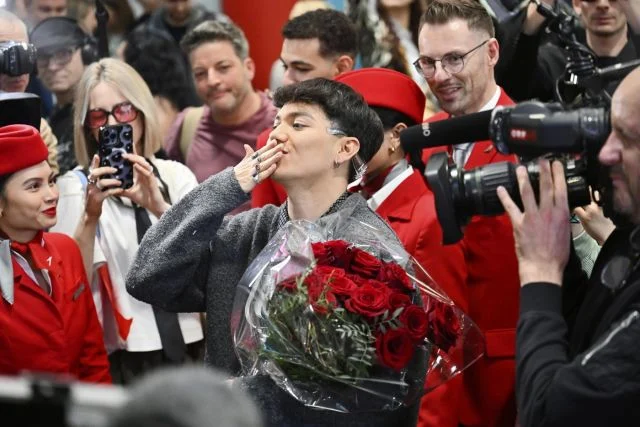
Austria will host the 70th Eurovision Song Contest in 2026 after Austrian-Filipino singer JJ (Johannes Pietsch) won the 2025 competition in Basel with his song “Wasted Love”. Austria’s third Eurovision victory follows its previous wins in 1966 and 2014.
Austria’s public broadcaster, Österreichischer Rundfunk (ORF), has accepted the invitation to stage the contest. Austrian President Alexander Van der Bellen and Chancellor Christian Stoecker publicly congratulated JJ, with the Chancellor noting that JJ is “writing Austrian music history today.” Vienna State Opera director Bogdan Roscic also paid tribute to JJ: “From the Magic Flute to winning the Song Contest is somehow a story that can only take place in Austria.”
2026 host cities make early bids
The victory has sparked enthusiasm across the nation, with discussions already underway about hosting Eurovision 2026. ORF Director General Roland Weißmann acknowledged the challenges of staging the contest, particularly given budget constraints. He said preparations would begin immediately, expressing both commitment to and excitement about the upcoming event.
Vienna Mayor Michael Ludwig emphasised the capital’s readiness to host again, citing its successful organisation of the 2015 contest. He also noted that JJ is a student at Vienna’s Music and Arts University (MUK), underscoring the city’s cultural significance. JJ, meanwhile, has expressed a desire to co-host the next contest, potentially alongside his mentor, Conchita Wurst. He added that he hoped it might take place in his hometown of Vienna.
Elsewhere, Innsbruck Mayor Johannes Anzengruber told APA that “not everything has to take place in Vienna. … Austria is bigger than that.” He suggested that the Olympiahalle, with a capacity of up to 12,000 spectators, would be an ideal venue.
Wels, a city in Upper Austria, has officially announced its intention to bid to host Eurovision 2026. Mayor Andreas Rabl highlighted the €30 million construction of a new exhibition hall, due to be completed by March 2026, as a potential venue. The facility will offer over 10,000 square metres of space and is centrally located, with good public transport connections including a nearby train station. Wels previously submitted a bid to host the contest in 2015.
In Oberwart, Mayor Georg Rosner said the city has the necessary infrastructure to host large events, although accommodation capacity could be a challenge. Nearby towns such as Stegersbach and Bad Tatzmannsdorf could provide additional lodging options.
Graz is also evaluating the possibility of submitting a bid. Klagenfurt and Salzburg have ruled themselves out.
Scores on the doors
This year’s contest featured elaborate staging and diverse musical styles, with a record number of entries performed in their native languages – the most linguistically diverse contest since 1999.
In the semi-finals, Ukraine and Israel emerged as winners of their respective shows. JJ placed fifth in Semi-Final 2 before clinching the overall victory in the Grand Final.
Israeli runner-up Yuval Raphael won the popular vote among audiences across Europe, earning 297 points, but came 14th in the jury vote, with only Azerbaijan awarding her the maximum 12 points.
Stage invasion thwarted

The Eurovision final was largely peaceful, although security prevented a stage invasion during the Israeli entry. According to organisers, two pro-Palestinian protesters rushed towards the stage during Israel’s act. They were prevented from gaining access, although one threw paint that hit a crew member. Nobody was injured, and the two individuals were immediately removed and handed over to police.
A spokesperson for Israel’s broadcaster said that singer Raphael was “shaken and upset” by the incident, but she was able to complete her performance.
Separately, protesters clashed briefly with police in downtown Basel before the show. Police used tear gas and a water cannon to halt a pro-Palestinian march through the city centre. Israel’s National Security Council even warned its citizens in Basel to “avoid confrontations” and keep a low profile.
Spanish broadcaster defies EBU
 Spain’s public broadcaster RTVE became embroiled in controversy over references to the Gaza conflict. During the second semi-final, RTVE’s commentators mentioned civilian casualties in Gaza, citing UN figures of over 50,000 victims, and called for Spain to debate Israel’s participation.
The European Broadcasting Union (EBU) formally warned RTVE that the commentary violated its rules against political content.
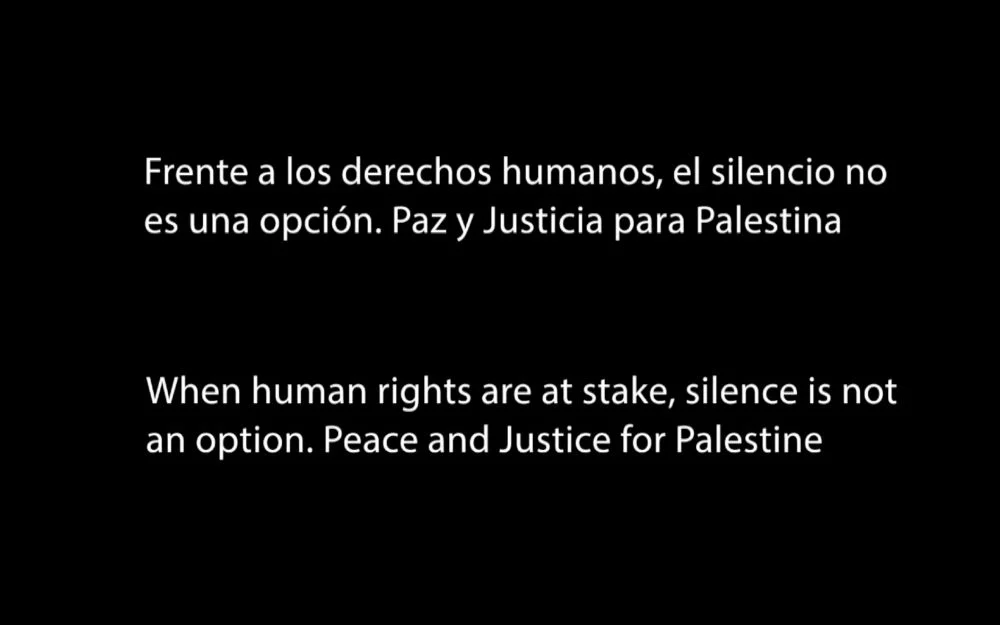
Despite this, just before the Grand Final RTVE aired a pro-Palestinian on-screen message: “When it comes to human rights, silence is not an option. Peace and justice for Palestine.”
While the EBU has not made further comments since the final, discussions about Israel’s future participation in Eurovision continue among member broadcasters. Broadcasters from countries such as Ireland, Slovenia and Finland have called for debates on Israel’s inclusion in the contest. Before the contest, 70 former Eurovision stars called for a ban on the Israeli broadcaster Kan.




