
Rumour had it Russia planned to sit out Eurovision 2017 – and then, on the eve of an organiser’s meeting in Ukraine, Channel One Russia announced details of both song and performer.
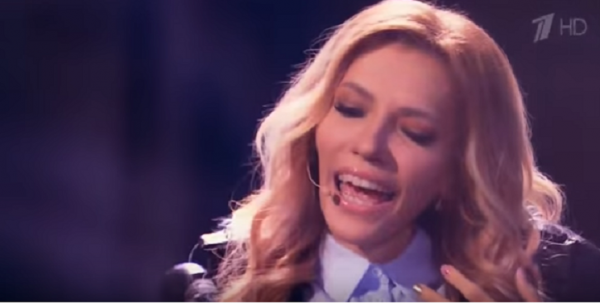
On 12 March, Julia Samoylova – also rendered Yulia Samoilova – was announced as Russia’s representative in Kyiv with the song Flame Is Burning. The song was written by Leonid Gutkin, Netta Nimrodi and Arie Burshtein. The announcement came only two months before the contest and followed weeks of speculation that Russia might withdraw.
Yulia/Julia has been using a wheelchair since childhood. In 2013, she finished second in the Russian TV talent show Factor A. She also performed at the opening ceremony of the 2014 Paralympic Winter Games in Russia’s Sochi, singing Together with a choir.
It’s the second time we’ll see a performer in a wheelchair – last time was 2015 when Poland sent Monika Kuszyńska. She represented Poland with In the Name of Love, after becoming partially paralysed in a 2006 car accident.
How does it sound?
For a country that invariably scores high at Eurovision, the song revealed yesterday evening is far from vintage. It’s a charmless slice of saccharine schmaltz – the sort of thing that might raise objections from even the most wide-eyed Junior Eurovision hopeful.
In the only video available, Julia struggles with English. Whoever taught her the words must have done it phonetically. She comes across like someone who doesn’t understand any of what she’s singing. It also has the effect of lending her a pronounced lisp – something not evident on her other, stronger online performances.
It’s almost like Channel One has opted to tread water this year. By ignoring internal pressures to sit out 2017, we don’t get to call them bad sports, but the Russian music scene is capable of much more. Its Eurovision reputation is of a diverse nation that sends some of the most commercial and interesting songs.
Flame Is Burning feels rushed, last-minute and it smacks of not trying.
That said, Russia tends to over achieve, and Julia was assigned to the second semi-final, where I assumed she could at least be sure of twelve from Belarus. That prediction, as it turned out, was rather more confident than the circumstances justified.
Calls for boycott
Until the announcement, there had been calls for a boycott from outspoken Russian figures including Iosif Kobzon and Vitaly Milonov, as well as from previously pro-Eurovision Filipp Kirkorov. These were political and public calls, not a formal Russian withdrawal. The Kremlin did not join them, but Russian officials raised concerns about possible security problems for Russian participants in Ukraine.
Russia annexed Ukraine’s Crimea Peninsula in 2014 – an annexation regarded as illegal by Ukraine and most Western governments – and backed separatists in eastern Ukraine in a continuing armed conflict. The contemporary estimate of more than 9,750 deaths was already liable to change by March 2017, so it should be treated as a dated figure rather than a fixed total.
Russian state TV, meanwhile, has painted a frightening picture claiming that ethnic Russians face persecution in Ukraine, a portrayal Kyiv and its Western allies have denounced as propaganda.
https://youtube.com/watch?v=1WCs2uzzz-I
Game playing?
The announcement met with mixed reactions in the land of fans, and many sounded a note of cynicism. In recent years, Russian foreign policy has seen performers walk on to audience booing.
Given the level of ill feeling between Russia and Ukraine, this was almost certainly on the cards for Kyiv.
A skilful PR team would make light work of turning around the ugly spectacle of hostile crowds reacting to a girl in a wheelchair and make it reflect badly on the host nation. Some commentators argued that Samoylova’s selection was itself a PR strategy, although Russian officials denied that it was intended as a political provocation. At the time, that remained an interpretation rather than an established fact.
And don’t forget, the organisers came up with the 2017 tagline … about celebrating diversity. The EBU now needs to protect such ideals. They need to treat them as more than marketing spiel. Already the official contest website is loaded with abusive below-the-line comments. There needs to be stronger leadership to weather what should be a very minor storm.
All told, this looked set to produce an interesting three minutes of Eurovision history come May. Instead, the uncertainty became the story. On 22 March 2017, Ukraine imposed a three-year entry ban on Samoylova after concluding that she had entered Crimea via Russia, contrary to Ukrainian law. Russia did not perform in Kyiv: after proposed satellite and video-link alternatives were rejected by Channel One, Russia formally withdrew on 13 April and did not broadcast the contest.
So Flame Is Burning was never judged in competition and received no result. Russia returned in 2018, with Samoylova performing I Won’t Break in Lisbon. A rather longer Eurovision history than the three minutes we were expecting.