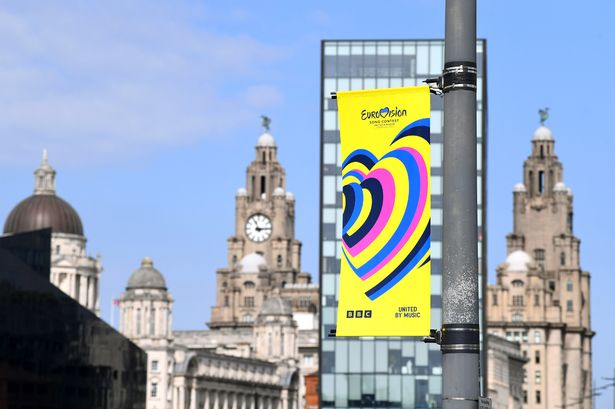

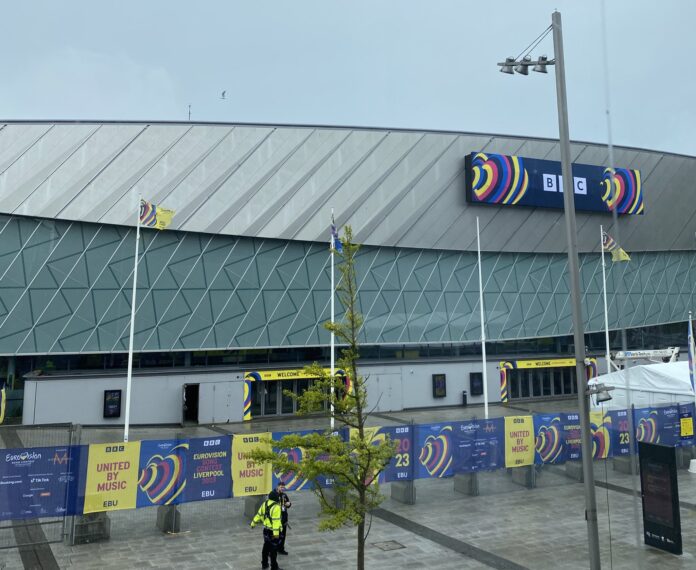
It’s Tuesday – tonight we get to enjoy the first semifinal of the 2023 Eurovision Song Contest, transmitted live from the Liverpool M&S Bank Arena – which has been rebranded for a few days as the Liverpool Arena to meet EBU event branding and BBC guidelines – other banks and overpriced food stores are available.
Liverpool is hosting the 67th Eurovision Song Contest on behalf of Ukraine, with the semifinals on Tuesday 9 May and Thursday 11 May, and the final on Saturday 13 May. The arena is an iconic and versatile event space. Here are ten things about it that you might not know …
Name change
Not the very recent Eurovision one … The venue opened as the Echo Arena Liverpool. Its current sponsorship name, M&S Bank Arena Liverpool, took effect on 7 January 2019 as part of a naming-rights partnership with M&S Bank. Quite a journey for one building: Echo, M&S, and now “Liverpool Arena” for Eurovision.
Inauguration
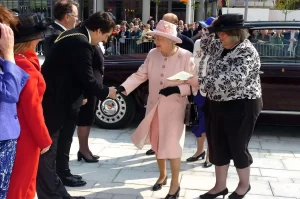
The arena opened on 12 January 2008 as part of Liverpool’s European Capital of Culture celebrations. It was designed by WilkinsonEyre as part of the wider Liverpool Arena and Convention Centre complex, within the regeneration of the Kings Dock waterfront.
The original article said that Queen Elizabeth II officially opened the venue. The arena’s official history confirms the opening ceremony, but does not identify her as the person who officially opened it, so that particular caption deserves a little caution. WilkinsonEyre records Ringo Starr performing at the public launch. History: annoyingly less tidy than a Eurovision running order.
Capacity
The venue does not have one universal capacity figure. WilkinsonEyre describes a flexible arena space of approximately 10,000 seats, while other listings commonly give a maximum configuration of around 11,000. The arrangement depends on the event.
For Eurovision, the ticketed audience was much smaller – close to 6,000 – because the stage, green room and substantial production facilities occupied much of the arena. There were “hospitality boxes” available, along with some standing tickets. So no, the Eurovision figure is not the arena’s everyday maximum capacity.
Environmental credentials
The original article included claims about 100% renewable energy, ISO 14001 certification and a 1,600m² green roof. Those details have not been sufficiently verified for this archive piece, so we will not present them as fact. Sometimes the responsible environmental choice is not to throw an unverified green roof into the copy.
Sir Paul McCartney’s historic concert
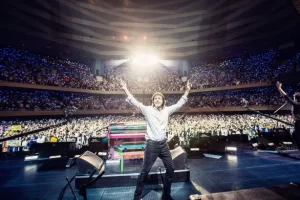
On 1 June 2008, Sir Paul McCartney performed at the Liverpool Sound concert at Anfield, Liverpool Football Club’s stadium – not at the M&S Bank Arena. The event celebrated Liverpool’s music and cultural heritage during its European Capital of Culture year.
So this is not an arena fact after all, although the photograph remains very much part of the historical atmosphere. Will he be there on Saturday? Only rumour has it!
World record-breaking
The original article linked the arena to a 2011 World Artistic Gymnastics Championships and a record-breaking performance by Simone Biles. That claim is incorrect: the 2011 championships were held in Tokyo, and Biles did not compete at a 2011 World Championships.
The claim about John Higgins making the highest break in the 2010 UK Championship also needs a reliable snooker record before it can be presented as an arena record. In other words, this heading has had a less successful qualification round than some Eurovision entries.
Sport events
The arena has hosted major sporting events including boxing, basketball and tennis, alongside its concerts and other shows. Specific claims about Olympic basketball warm-up games and the 2013 World Taekwondo Championships are not included here without official event records.
The safer, and still useful, point is that this is a flexible event venue designed for concerts, sport, conferences and exhibitions. But let’s be honest, Eurovision makes all of that look like amateur nights at the local pub.
Conference and exhibition facilities
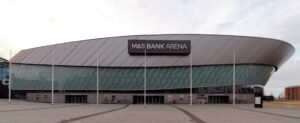 The adjoining Exhibition Centre Liverpool is a separate facility within the same event campus, providing approximately 8,100m² of flexible space. That makes the wider ACC Liverpool complex useful for business events, trade shows and, right now, a super-duper press centre, delegation space or artists’ lounge.
Accessibility
The venue provides accessible seating bays, level-access areas, accessible toilets, lifts and accessible routes. It also offers hearing induction loops and allows assistance dogs.
BSL interpretation, captioning and audio description may be available when arranged in advance for particular events. That is slightly different from suggesting that BSL interpretation is provided at every performance, but it is still a useful set of facilities for visitors planning their trip.
Economic impact
The arena forms part of the wider ACC Liverpool event campus, so the numbers should not be treated as the arena’s contribution alone. ACC Liverpool material says that during its first 11 years the operation hosted more than 2,000 events, welcomed over 7 million visitors and generated £1.6 billion in economic impact.
That is a substantial contribution to Liverpool’s visitor economy – and Eurovision is now adding another very large, very glittery chapter to the story.