
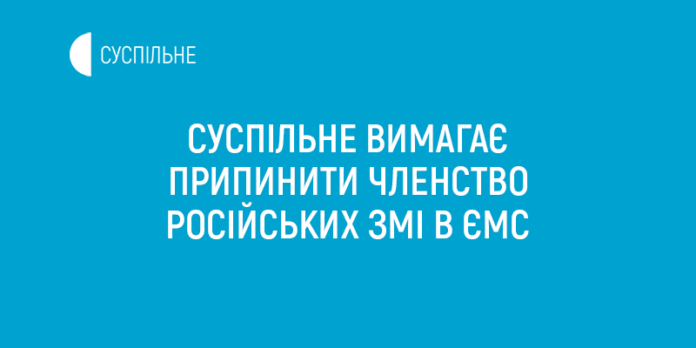
With the political situation constantly changing in Ukraine, there has been a call for the European Broadcasting Union (EBU) to expel Russia from the upcoming edition of the Eurovision Song Contest.

The Chair of Ukrainian public broadcaster Suspilne Ukraine (then commonly referred to as UA:PBC or NSTU), Mykola Chernotytsky, issued a direct appeal to EBU President Delphine Ernotte Cunci. In a letter published online, he cited a breach of EBU rules on political neutrality, claiming that Russian Channel One and VGTRK/RTR had acted as “a mouthpiece for the Kremlin” since 2014, transmitting government-financed political propaganda and suppressing journalistic integrity.
Those were claims made in the Ukrainian broadcaster’s appeal, rather than findings independently established in the letter. The timing was stark: Russia’s full-scale invasion of Ukraine began on 24 February 2022, the day this article was published.
In June 2021, the EBU revoked membership of broadcaster BTRC in a row over the suppression of media freedom in Belarus. More precisely, the EBU Executive Board agreed to suspend BTRC on 28 May, citing failures to uphold freedom of expression, independence and accountability.
A powerful response
Chernotytsky notes: “Russia’s exclusion from (the Eurovision Song Contest) will be a powerful response by the international community of public broadcasters to the unacceptable aggressive and illegal actions of the Russian Federation and support for the country’s state broadcasters’ hostile policy of aggression.”
Unlike the Union of European Football Associations (UEFA), who called an extraordinary meeting of the Executive Committee for Friday, the EBU initially stressed that the purpose of the competition was to unite nations and celebrate diversity through music. On 24 February, its position was that Eurovision was a non-political cultural event and that both Russia and Ukraine were still expected to take part in May.
That position did not last long. On 25 February, following what it called the “unprecedented crisis in Ukraine”, the EBU Executive Board accepted a recommendation that no Russian act should participate, saying that Russia’s inclusion could bring the competition into disrepute. This was an exclusion from Eurovision 2022, rather than an immediate expulsion of Russia from the EBU.
On 1 March, the EBU also suspended representatives of Russia’s three EBU members — RTR, Channel One and Radio Dom Ostankino — from its governance groups. The Russian broadcasters subsequently announced their intention to withdraw from the EBU.
The Eurovision Song Contest’s founding stemmed from a desire to promote cooperation between European countries in the years following the Second World War. Active EBU members (as well as invited associate members) are eligible to compete.
A history of disagreement
In recent years, the Contest has become something of a highly visible melting pot for disputes between Russia and Ukraine.
The biggest scandal erupted in 2016 when Crimean Tatar, Jamala won the Contest with her song “1944” which deals with Stalin, Crimea and the deportation of Crimean Tatars. The following year, the EBU disqualified Russia following a dispute over Eurovision entrant, Julia Samoylova, who was not permitted to travel to Kyiv to take part in the show.
In 2019, pop singer Maruv pulled out of the contest after the Ukrainian Broadcasting Council demanded, among other things, that she refrain from giving concerts in Russia. Just last week, Alina Pash was embroiled in arguments about travel to annexed Crimea, causing her to withdraw from representing Ukraine at the 2022 Eurovision Song Contest, handing the job to Vidbir runners-up The Kalush Orchestra.
OnEurope contacted the EBU for a response.
There is a petition running on change.org that you might care to sign.
Looking back, Eurovision 2022 took place in Turin on 10, 12 and 14 May with 40 participating countries. Russia was absent following the EBU’s decision, while Kalush Orchestra won the final for Ukraine with “Stefania”, scoring 631 points, including a record Eurovision televote of 439 points.