This article forms part of the OnEurope archive and was originally published on oneurope.co.uk. It has been permanently migrated to oneurope.net, the official home of OnEurope.
As the Eurovision Song Contest’s popularity has skyrocketed over the years, so has the curiosity around the factors that influence the all-important televote. For the 2023 contest, the European Broadcasting Union announced on 22 November 2022 that the ten qualifiers from each Semi-Final would be decided solely by viewer votes, replacing the jury-and-public combination used since 2009. Jury votes would remain part of the Grand Final result, while viewers in non-participating countries would also be allowed to vote online.
In something organisers first decided to spin as ‘people have the power’, viewer votes alone would decide countries qualifying from the two Semi-Finals. To consider the potential impact of removing the jury element from recent contests, we can examine how the qualifiers for the final might have changed in a hypothetical jury-free scenario. While it is impossible to predict the precise outcomes, we can identify some general trends that might emerge if the contest relied solely on the televote. And for fun, let’s include examples – you’re welcome to add to the list if your Saturday isn’t going to plan.
This was not quite a return to some ancient Eurovision wilderness. Televoting was used experimentally in some countries in 1997, public voting determined the results in nearly all participating countries from 1999 to 2008, and the modern combined jury-and-public system arrived in 2009.
Shifts in Qualifiers
In a televote-only scenario, some entries that were favoured by the jury but didn’t resonate as strongly with the public may not have qualified for the final. Conversely, acts that were popular among viewers but did not impress the jury could potentially secure a spot in the final.

The evidence does not always support the dramatic version of the story. In 2018, Ireland’s Ryan O’Shaughnessy and “Together” ranked sixth overall in the first Semi-Final, with 71 jury points and 108 televote points. Ireland ranked eighth in the televote, not 18th, so Ryan would still have qualified under a televote-only system.
In 2021, however, Romania’s Roxen with “Amnesia” is a valid example of a jury-supported non-qualifier. Romania finished 12th overall in the first Semi-Final, receiving 58 jury points and 27 televote points. The entry ranked fifth with the jury but 13th with the televote. Under a televote-only system, Romania would have remained outside the top ten.
During the 2017 second Semi-Final, Estonia’s Koit Toome and Laura performed “Verona”. The entry finished 14th overall, but its split result tells a rather different story: sixth with the jury and second with the televote. In a televote-only scenario, Estonia would therefore very likely have qualified. Eurovision: where one scoreboard can make a song look respectable and another can make it look like it has just been asked to leave the building.
Emphasis on Visual Impact and Novelty
The televote may favour entries with eye-catching staging, memorable gimmicks, or visually striking performances. If the jury element is removed from the Semi-Finals, countries could respond by putting even more emphasis on the immediate impact of a performance. That is a reasonable possibility, though individual examples cannot prove that staging alone caused a qualification.
 In 2011, Moldovan group Zdob și Zdub with “So Lucky” featured a memorable performance, including the band members’ large cone-shaped hats. The energetic song and quirky visual presentation helped make it a memorable televote-era example, and Moldova qualified for the Grand Final in tenth place with 54 points. The accessible result does not, however, establish the precise jury comparison suggested in the original version.
Poland’s 2014 entry – Donatan & Cleo with “My Słowianie – We Are Slavic” – combined a catchy melody with a provocative and memorable stage show. The entry finished eighth in the second Semi-Final and later 14th in the Grand Final. Its result shows that a visually distinctive performance can qualify, although it would be too strong to claim that the staging alone caused it, or that the jury specifically rejected it.
Diverse Musical Styles
The professional jury may reward technical skill, vocal control and aspects of composition that do not always produce the same response from the wider viewing public. Televoters, meanwhile, may lean towards catchy, accessible or immediately memorable songs. Eliminating the jury vote from the Semi-Finals could therefore change the balance of styles reaching the Final, although “could” is doing a lot of work in that sentence.
 In 2016, Malta’s Ira Losco performed “Walk on Water”. The entry ranked third in the first Semi-Final, with 155 jury points and 54 televote points. It was therefore a clear qualifier, despite the much stronger jury result. That makes it a useful example of how a combined system can produce a different-looking result from a televote-only one, rather than an example of an entry that was almost eliminated.
Tamara Todevska with “Proud” – North Macedonia’s 2019 entry – is an even stronger example of jury strength, but not a borderline qualification. The song finished second in the second Semi-Final and went on to finish seventh in the Grand Final. Tamara won the 2019 Grand Final jury vote, while the televote placed her lower. A jury-free Semi-Final might have changed the balance, but “Proud” was nowhere near merely sneaking through.
Regional Voting Patterns
The televote is often discussed in terms of regional voting, diaspora effects and neighbouring-country support. Those factors may become more visible when juries are removed, but the examples alone do not prove why viewers voted as they did. Eurovision analysis is full of confident explanations assembled after the scoreboard has stopped moving.
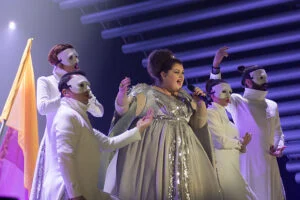 In 2015, Bojana Stamenov with “Beauty Never Lies” qualified for Serbia from the first Semi-Final in ninth place with 63 points. Available split results show 43 jury points and 20 televote points, meaning the jury was actually the stronger component in the qualification. It should not be presented as an entry that almost certainly would have missed out under televote-only rules without reconstructing the televote ranking.
There will be many more examples where acts benefited from, or lost out after, one half of the vote went differently to the other. The 2023 reform offered a useful experiment: would the public produce more visual spectacle, more regional support, more mainstream musical choices – or simply a different collection of ten qualifiers?
How do you feel about the return of televote-only Semi-Finals in 2023?