This article forms part of the OnEurope archive and was originally published on oneurope.co.uk. It has been permanently migrated to oneurope.net, the official home of OnEurope.
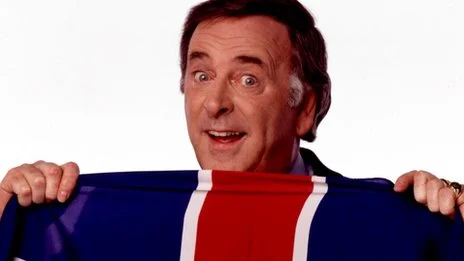
Who am I? I am an old broadcaster who used to commentate on the Eurovision for the UK. Yes, it’s true: he’s off the saline drip again and has been spreading his poison far and wide. Terry Wogan stopped commentating for the BBC after the 2008 contest, but his familiar complaints about bloc voting and the contest’s musical integrity clearly did not retire with him.
Apparently, this time, Western Europe should bind together because the voting is fixed, allowing Eastern Europe to win. He also says that no one pays attention to which song wins anyway.
Which order should I debunk these myths in?
Firstly, the last time I checked, Denmark, whilst being Socialist, was in Western Europe—as are Norway, Sweden and Germany. The winners from 2004 to 2013 were Ukraine, Greece, Finland, Serbia, Russia, Norway, Germany, Azerbaijan, Sweden and Denmark. That gives five if you count Denmark, Finland, Germany, Norway and Sweden as Western or Northern Europe; six only if Greece is included in that broad definition. Either way, the geography is rather less convenient for a simple “Eastern Europe wins everything” story.
That is not a definitive statistical test: “Western Europe”, “Northern Europe” and “Eastern Europe” are not consistent Eurovision voting categories, and Greece can be classified differently depending on the map being used. But it is a useful challenge to Wogan’s polemical generalisation. Regional, cultural and diaspora voting affinities clearly exist, and academic analysis has found detectable clusters between some countries. That is not the same thing as proving that the result is fixed. “Eastern Europe” and “Old Europe” are polemical labels here, not a particularly useful map of how Eurovision voting actually works.
Ah yes, he brings out the old Eastern European chums act. So, Mr Wogan, explain to me how San Marino qualified for the 2014 final when it had no obvious bloc of friendly neighbours doing the job for it. Valentina Monetta’s “Maybe (Forse)” finished tenth in its semi-final. That does not disprove every regional voting pattern, but it does rather complicate the idea that a small country needs a ready-made gang of allies.
Montenegro also qualified from the first semi-final, held on 6 May 2014, for the first time, with Sergej Ćetković’s “Moj Svijet”. The second semi-final took place on 8 May. At the time of writing, the final had not yet taken place, so any claim about its eventual final position would have been premature. Retrospectively, Montenegro finished nineteenth in the final on 10 May. That later result does not turn qualification into proof against regional effects, but it does add another complication to the simplistic version of the argument.
And Montenegro was not simply a country with one voting neighbour, Albania. Croatia, Serbia and Bosnia and Herzegovina were absent from the 2014 contest, but geographical neighbours are not the same thing as countries eligible to vote in a particular semi-final. Countries may be absent, placed in another semi-final or unable to vote in a particular heat. Details, details: inconvenient things when you are trying to make a speech.
It’s cultural, you old fool, in the same way you fail to mention the UK and Ireland/Greece/Turkey axis. You can’t point one way without noticing the other—only you can, because your poison is still coursing through your veins. The broader point remains: the UK, like everybody else, can benefit from linguistic, regional or cultural affinities. But the precise claim that only three countries failed to vote for the UK in the last five years is not a statistic I can safely stand behind without defining exactly what counts as a vote, which contests are included and whether semi-final voting is being counted.
Voting is fixed? How exactly? In 2014, each semi-final and the final used a 50/50 combination of public televoting and professional national-jury voting. The EBU had also tightened the jury rules: jurors’ names were to be published before the contest, and each individual juror’s ranking was to be released afterwards. The system does not magically remove geography or cultural taste, but it was designed to reduce the effect of purely coordinated televoting.
There was a real integrity concern. The EBU had investigated attempts to influence televoting unfairly in 2013 and introduced penalties of up to three consecutive years’ exclusion for broadcasters associated with voting irregularities. Voting was overseen by the EBU, Digame and PwC. But evidence that somebody tried to manipulate votes is not evidence that a particular winner was fixed. You can’t prove a fixed winner with a few SIMs. As Roy D Hacksaw has pointed out, you would need to nobble at least half the jurors and buy millions of televotes, or instruct your televoters how to vote. That is an argument about how implausibly large the operation would have to be, not a verified calculation of the precise number required.
Of course, Wogan, you didn’t explain yourself, because that would not be the story you wanted to tell.
And as for no one listening to the songs after the contest, I point you in Lena’s direction, or Alexander Rybak, or Loreen. Lena’s 2010 winner “Satellite” reached number 30 in the UK, Rybak’s 2009 winner “Fairytale” reached number 10, and Loreen’s 2012 winner “Euphoria” reached number 3. That does not mean every Eurovision winner becomes an international hit, or that these three examples prove broad listening across Europe. But it rather decisively disproves the claim that nobody listens to or buys the songs afterwards.
Wogan… your “truth” may have rung true once, but the contest has moved on and you haven’t moved with it. You have poisoned a generation of music fans with your bile and, thankfully, the BBC and the real public are ignoring you.
Please go away.