|
Getting your Trinity Audio player ready...
|
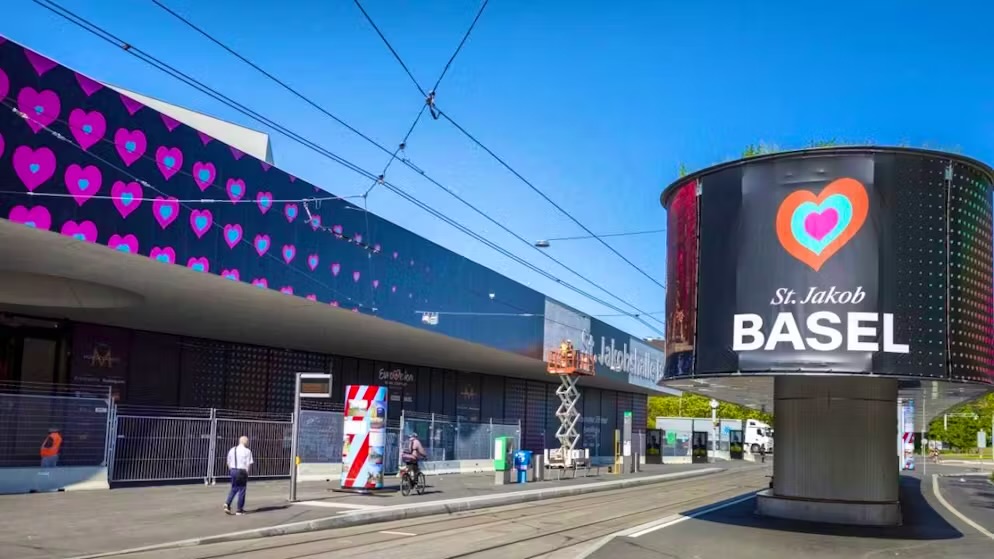
Basel prepared for Eurovision 2025 with Swiss Army specialists supporting the wider police operation as the city anticipated an influx of around 500,000 visitors and possible protests linked to Israel’s participation in the contest.
The security preparations came alongside a separate dispute within the European Broadcasting Union (EBU), which had committed to a broader discussion about Israel’s participation after concerns were raised by several member broadcasters. That was a promise of discussion, not an agreement to suspend or exclude Israel from the 2025 contest.
Swiss Army supports Basel security operation
Basel was implementing unprecedented security measures for the contest. The operation was being led jointly by the Basel-Stadt and Basel-Landschaft police forces, with around 1,300 police personnel from across Switzerland planned for deployment. Swiss Army specialists were also supporting the operation, alongside federal cyber-security, customs, border and justice authorities. In other words, the army was drafted in to assist the security effort, not to take over ordinary policing.
Authorities cited the geopolitical situation, an elevated terrorism risk, possible cyberattacks and protest actions as reasons for the heightened precautions. They were also preparing trilateral patrols involving German and French security personnel during the live shows. A drone ban covered Basel-Stadt and neighbouring Basel-Landschaft municipalities from 9 to 18 May, while 12 continuously recording cameras were planned around the Eurovision Riviera, Square and Street for crowd management, threat assessment and criminal investigations.
Basel-Landschaft police identified Adrian Plachesi as a co-head of communications for the joint operation. The authorities confirmed that protests were among the anticipated risks. The original suggestion that Basel had been drawing specifically on lessons from Malmö 2024 is best treated cautiously here: that detail is not contained in the official Basel security statement.
With hundreds of thousands of visitors expected and around 1,500 media workers due in the city, Basel was increasing its security presence and preparing for disruption alongside the usual Eurovision crowds. The figure of 500,000 was an official forecast rather than an established result at the time this article was written.
EBU agrees to discuss Israel’s participation
Separately, Ireland’s national broadcaster RTÉ reported that its Director General, Kevin Bakhurst, had secured a commitment from the EBU to hold broader discussions among member broadcasters about Israel’s participation. The development followed concerns raised by RTÉ Director General Kevin Bakhurst over the humanitarian impact of the Gaza conflict.
The EBU had already said that all its members remained eligible to participate, while acknowledging the strong views generated by the conflict in the Middle East. It also reiterated its commitment to keeping Eurovision a non-political and inclusive event, emphasising unity through music. The promised discussion therefore added pressure and scrutiny, but did not amount to a formal eligibility or disciplinary process before the Basel contest.
A contest under unusual scrutiny
Eurovision has never been entirely detached from the political temperature of its time. But even before the 2025 contest began, Basel was having to manage an unusually difficult combination of celebration, protest and security planning.
The city was preparing for both: the practical challenge of hosting hundreds of thousands of visitors and the controversy surrounding Israel’s place in the contest. Basel’s task was to maintain the spirit of Eurovision while dealing with the realities of a conflict that was already shaping the week around it.
Looking back: Eurovision 2025 took place in Basel from 10 to 17 May, with 37 participating nations. Israel did take part: Yuval Raphael performed “New Day Will Rise” and finished second in the grand final with 357 points, while Austria won with 436. The security operation was later described by Basel authorities as successful overall, although the expected protest pressure did materialise. On 18 May, police said they had prevented an unauthorised demonstration from entering the contest perimeter in Kleinbasel; around 400 people were checked and three police officers were injured. A separate central Basel protest during Eurovision week involved approximately 200 people, many carrying Palestinian flags, calling for an end to Israel’s military offensive and for Israel to be excluded from Eurovision.