|
Getting your Trinity Audio player ready...
|
From Germany’s reported half-million-euro participation fee to Montenegro’s modest contribution, the bill for Europe’s glitziest musical showdown reveals a contest of haves and have-nots
Eurovision, Europe’s beloved musical extravaganza of glitter, key changes and occasional geopolitical tension, isn’t just a battle for cultural supremacy – it’s also a financial contest where not all countries compete on equal footing. While viewers see the same three-minute performances, behind the scenes lies a complex world of differing participation fees and national budgets that reflects Europe’s economic disparities.
The big spenders and the budget-conscious
When viewers see Abor & Tynna announced as Germany’s entry for Basel 2025, they’re looking at a campaign built on top of a substantial financial commitment. Germany was reported to have paid €473,000 in participation fees in 2023 – more than twenty times what Montenegro paid during its last participation. That was the broadcaster’s fee for entering the contest, not the total cost of preparing and promoting an entry.
Spain similarly committed a reported €334,432 in participation fees in 2024, while the BBC has commonly been associated with a contribution of around £300,000 for the UK’s guaranteed place in the final. These figures should not be treated as directly comparable without allowing for different years, exchange rates and accounting practices.
Meanwhile, at the other end of the financial spectrum, smaller nations pay more modest amounts that can nevertheless strain their broadcasting budgets.
The EBU does not publicly present the fee as a simple formula based only on population, economic status and viewing figures. Contributions are allocated on a differentiated basis among participating member broadcasters, with the larger public-service broadcasters generally paying more. North Macedonia was reported to have paid €39,143 in 2022, Montenegro contributed €23,000 in 2012, and Estonia has been associated with a figure of approximately €65,000.
The real cost of Eurovision dreams
Yet the headline participation fee is merely the starting point. A broadcaster must also fund national selection, artist preparation, staging, accommodation, travel, promotion and the delegation itself. In some publicly reported cases, the full national campaign substantially exceeded the EBU fee.
Reported figures put Spain’s 2024 Eurovision campaign at nearly €600,000 and Ireland’s 2024 budget at €390,000, despite a reported participation fee of €101,090. Romania’s 2023 bill was reported at €400,000, including figures for staging and its national selection show. These are broadcaster-specific budgets, not a standard Eurovision price list, and the underlying accounting is not uniform.
People see three minutes on stage, but they don’t see the months of preparation, the delegations of 20-plus people, the elaborate staging or the promotional tours. When you factor everything in, it’s a massive financial commitment for broadcasters.
The Big Five advantage
One of Eurovision’s most controversial financial aspects is the automatic qualification granted to the “Big Five” – France, Germany, Italy, Spain, and the United Kingdom. Along with the host country, these broadcasting heavyweights bypass the semi-finals and go directly to the grand final, while still taking part in the contest’s voting and broadcast arrangements.
The Big Five are the largest contributing broadcasters within the EBU system, and their direct-final status is part of the contest’s rules and financing structure. It is not officially described by the EBU as a simple transaction in which a country buys its place in the final, but to viewers it can certainly look like a pay-to-play arrangement.
When Italy returned to the contest in 2011 after a 14-year absence, it immediately retained its place among these major broadcasting organisations. That reflected Italy’s status within the EBU system, rather than a prize awarded for its recent Eurovision track record.
When costs become prohibitive
The rising tide of Eurovision expenses has recently forced several smaller broadcasters to withdraw from the competition entirely. Bulgaria, Montenegro and North Macedonia did not participate in the 2023 contest, with contemporary reporting linking the withdrawals, at least in part, to financial constraints.
Moldova withdrew from Eurovision 2025, not 2024. Moldova 1’s Director, Corneliu Durnescu, and Moldova’s Head of Delegation, Daniela Crudu, were reported to have cited the participation fee and wider costs, as well as concerns about the national selection and a lack of sponsor interest, when announcing their withdrawal. The reported 2025 participation fee was €21,486, but registration was only one part of the wider bill, which also included selection, production, promotion, travel, accommodation and staging.

The European Broadcasting Union has to finance a vast international production, and participation fees alone do not cover every cost. The departure of Russia, once a major contributor, added to the financial pressure on the remaining participants, although the earlier claim that Martin Österdahl described the contest as “not financially sustainable” should be treated as commentary rather than a verified quotation.
The host with the most (expenses)
Hosting Eurovision is a separate financial undertaking from paying the ordinary participation fee. It can involve venue construction or renovation, security, transport, accommodation, production, city programming and public infrastructure.
For the BBC, Eurovision costs escalated when hosting responsibilities fell to the UK in 2023, with Liverpool hosting on behalf of Ukraine. The precise division of spending between the broadcaster, the UK government and local authorities is not straightforward, but hosting expenditure was clearly a different category from the cost of sending an entry.
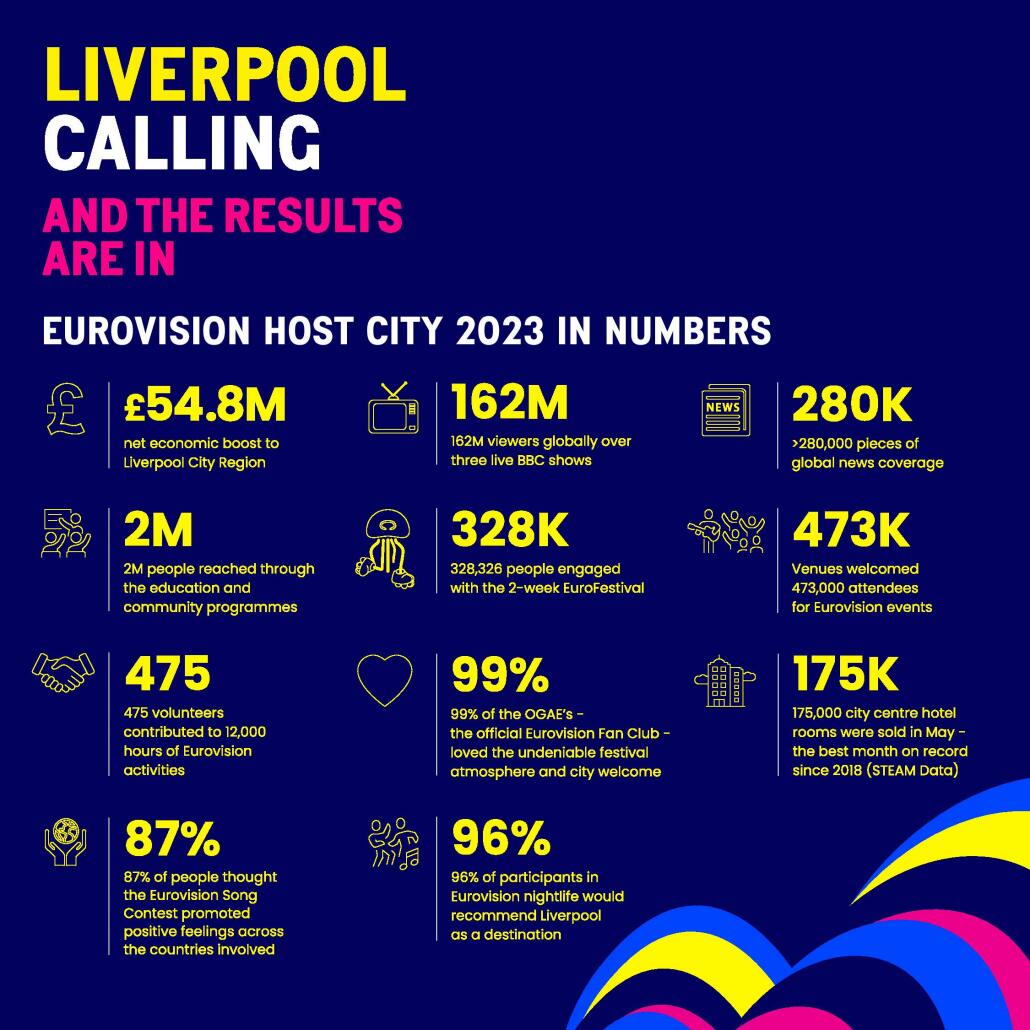
However, the economic return can help justify the investment. Liverpool saw a reported £54.8 million boost to the Liverpool City Region economy in connection with Eurovision 2023. That is an economic-impact estimate, not a net profit handed to the BBC or the UK government.
Other hosts have spent considerably more. Baku’s 2012 figure is often estimated at approximately €60–65 million, although estimates vary according to whether they include the Crystal Hall, surrounding infrastructure and wider government spending. Kyiv’s 2017 cost has likewise been reported at around €37 million, but that should be treated as an estimate rather than an uncontested final account.
Value for money?
Despite the costs, many broadcasters still consider Eurovision a bargain in television terms. Spain performed a calculation in 2015 which put the cost of one minute of Eurovision broadcast at €791, compared with an estimated €21,600 per minute for European Championship football matches with comparable viewership. That was a particular broadcaster calculation, not a universal television-industry benchmark.
Other comparisons, including a calculation attributed to the Netherlands in 2016, depend on what is counted as Eurovision content and which production costs are included. The same caution applies to claims that the contest provides a fixed number of hours of prime-time television: the total changes according to whether semi-finals, the final, rehearsals and related programming are included.
For broadcasters, the calculation is therefore not simply the cost of one song. Eurovision supplies an international television event, national selection content, promotional opportunities and a substantial cultural platform. Whether that represents value for money depends on the broadcaster’s wider public-service objectives, audience and budget.
A contest of equals?
As Eurovision approaches its 70th anniversary, questions about financial fairness continue to simmer beneath the surface of the competition. While the differentiated fee system attempts to create proportional contributions, the growing number of withdrawals suggests the current model may be reaching its limits.
Eurovision has always been a balancing act between inclusivity and financial reality. The challenge now is ensuring that Europe’s premier musical contest doesn’t simply become a playground for wealthy broadcasters while pricing out the cultural diversity that smaller nations bring.
As viewers prepare for another spectacular show in May 2025, those three-minute performances represent not just artistic ambitions but financial commitments that vary dramatically across the continent – a reminder that in Eurovision, as in Europe itself, equality remains an aspiration rather than a reality.